About tracy Malone
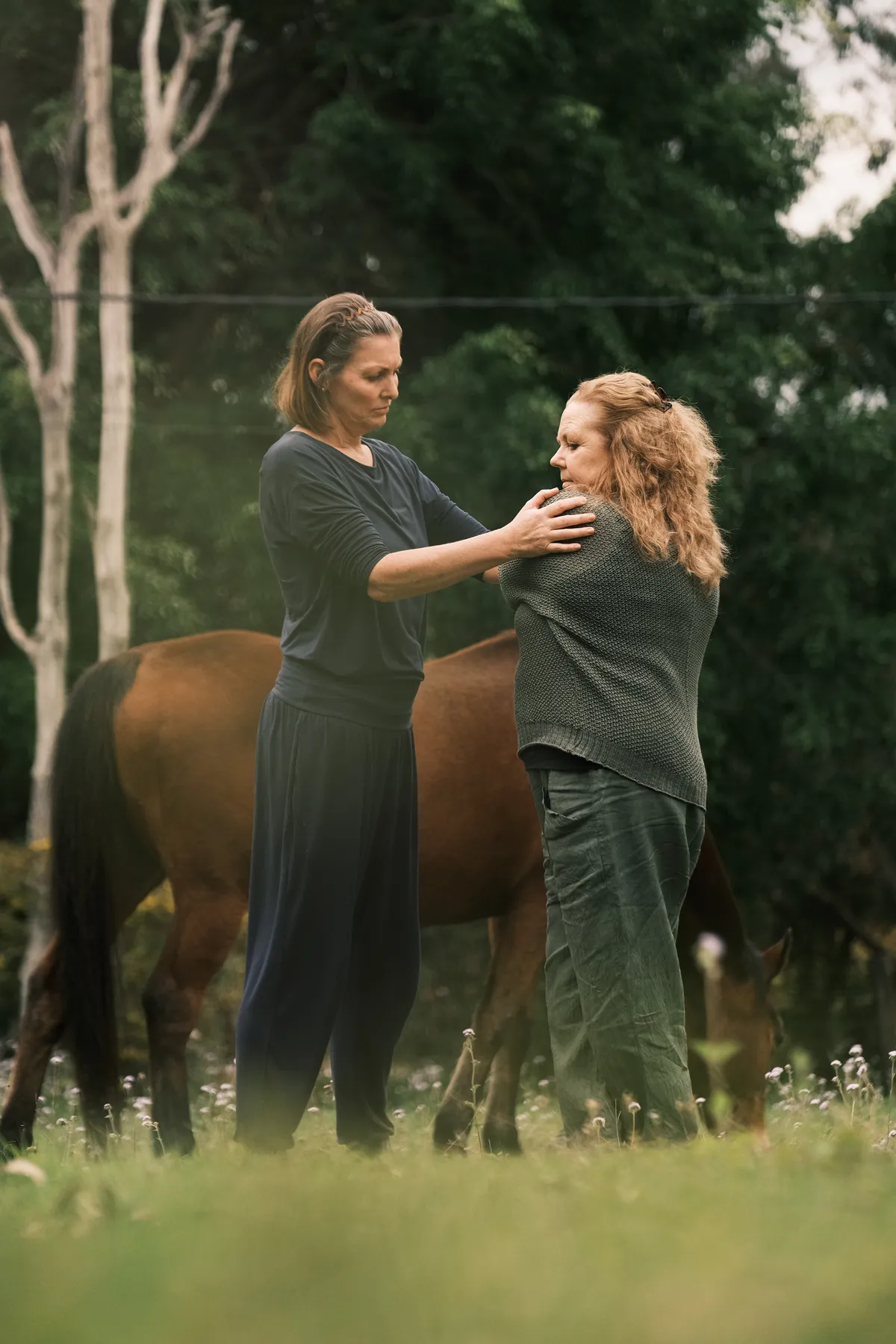
I have spent almost two decades learning to read what the body says beneath the words.
Fascia is Freedom brings that experience together with Human Garage fascial manoeuvres, Polyvagal-informed nervous-system work, vagus-nerve practices, and somatic tools.
My name is Tracy Malone - a holistic counsellor, somatic trauma coach, Family Constellations facilitator, and practitioner trained in TRE, Polyvagal Theory, and Human Garage fascial manoeuvres.
For more than 18 years, I have worked with people whose bodies were communicating something their minds could not fully explain.
I noticed the breath that stopped. The jaw that tightened. The shoulder that rose. The feet that lost connection with the ground. The surge of energy that had nowhere to go. The moment someone became quiet, urgent, far away, or organised around protection.
Long before I found fascial manoeuvres, I was reading bodies for a living.
Human Garage gave me a practical way to work with the physical web I could already see responding.
my curiosity has always taken me deeper
I am not someone who can stop at, "the trauma is held in the body."
I wanted to know where.
In my work, clients could often locate the experience clearly. They felt it in the throat, belly, chest, jaw, hips, shoulders, or somewhere else entirely.
Then it could move.
The pressure might begin in the chest and later appear in the jaw. A sensation in the belly might shift into the legs. The location could change while the underlying pattern still felt connected.
That fascinated me.
If trauma and stress are embodied, what connects one location with another? What is the body using to organise the pattern? Why can a person understand what happened, work deeply with the nervous system, and still feel something physical repeating?
I wanted more than a broad answer.
I wanted to understand the map.
Fascia kept appearing - but the usual explanations did not go deep enough
my questions led me into the world of fascia
I took courses. I read extensively. I learned about connective tissue and the web that surrounds and relates muscles, joints, bones, organs, nerves, posture, and movement.
The information was valuable.
But it did not answer the depth of the questions I was asking.
I did not only want to know what fascia was made of or where it was located. I wanted to understand how to work with it as a living, connected system. I wanted a practical model for the pressure, restriction, movement, emotion, energy, and changing patterns I witnessed in real bodies.
Then I found Human Garage.
Its philosophy matched the depth I had been looking for.
Human Garage sees fascia as far more than packaging around the important parts of the body. It sees fascia as the connected web through which pressure, sensation, movement, and information can be experienced across the whole system.
I often describe it as the internet of the body.
For the first time, I had a model that helped me make sense of why a painful area might be part of a wider pattern - and a practical method for working with that pattern through pinning and locking, counter-rotation, slow movement, breath, hands-on support, and walking integration.
Adding Human Garage to my training was not a random new certification.
It was the next natural fit.
The final piece was not fascia alone. It was how fascia connected everything I already knew.
My previous training had taught me to understand the body through somatic awareness, protective responses, generational and relational patterns, nervous-system state, co-regulation, movement, and completion.
Human Garage fascial manoeuvres gave me a practical way to add pressure and the connected fascial web to that model.
I could now bring three conversations together:
| The conversation | What I am reading | How I work with it |
|---|---|---|
| Pressure | Pain, restriction, bracing, compensation, or load held through the fascial web. | Human Garage fascial manoeuvres using pinning and locking, counter-rotation, slow movement, breath, hands-on work, and walking integration. |
| State | Activation, overwhelm, collapse, disconnection, restlessness, or difficulty returning from effort. | Polyvagal-informed nervous-system work and vagus-nerve support through breath, sound, orientation, pacing, movement, and co-regulation. |
| Completion | A protective impulse or stress response that began in the body but did not find a way to finish. | Somatic tools supporting sensation, movement, expression, boundaries, rest, and integration without forcing. |
Sometimes fascia is the clearest doorway.
Sometimes the nervous system needs support before the body is ready for more movement.
Sometimes the body is holding an unfinished adaptive pattern that it's ready to release - to turn, push, leave, speak, shake, breathe, rest, or set a boundary.
I know how to work across these levels and how to recognise which conversation your body can access now.
This became my complete working model for embodied healing.
Fascia is Freedom needed to become its own pathway
My deeper somatic trauma work continues through TracyMalone.co.
But fascial manoeuvres are too important to be hidden inside another business as one more technique on a long list.
They deserve their own entry point, their own education, and their own community of people learning to work with their bodies.
I also do not believe you need to enter deep trauma processing to experience value from this work.
You can arrive because your back keeps tightening. Because your jaw grips. Because your shoulders feel loaded. Because a practitioner helps but the familiar pressure returns. Because you are fascinated by fascia. Because you feel wired at night. Or simply because you want to move and feel more connected to your body.
You can learn fascial manoeuvres, practise nervous-system regulation, and build vagus-nerve capacity without turning every class into a deep exploration of your history.
That distinction matters.
It lets Fascia is Freedom remain practical, accessible, embodied, and focused - while my separate trauma-healing practice continues to offer a different depth and pathway for people actively seeking that work.
That is why Fascia is Freedom was born.
You are not working with someone who has simply learned a sequence
I know how to teach the Human Garage manoeuvres
But that is not the only experience I bring into the room.
You are working with someone who has spent more than 18 years listening to people, reading bodies, understanding nervous-system states, facilitating embodied and systemic work, and recognising the difference between a body that needs more movement and one that is already doing too much.
I notice when the breath changes. When a movement becomes effortful. When your body moves towards connection - and when it moves offline.
I can see when adding intensity will create more bracing. I can recognise when fascia is the best doorway, when the nervous system needs orientation first, and when the body needs time to walk, rest, settle, or complete something before we continue.
In an online class, that experience shapes my sequencing, pace, language, and guidance.
In a private session, it allows me to tailor the work to the body in front of me.
In hands-on fascial work, it helps me listen through my eyes and hands rather than applying a technique simply because it is next on a list.
You are not receiving a performance of expertise.
You are receiving the depth of almost two decades spent becoming fluent in how bodies communicate.
I respect the work and the practitioners that brought us here
I value physiotherapists, chiropractors, acupuncturists, massage therapists, osteopaths, counsellors, and other practitioners who support people every day.
Human Garage itself grew from a multidisciplinary bodywork environment.
Its founders saw that skilled work could help - and also saw people return with the same issue or something closely related to where they had begun.
The frustration was not that bodywork had no value.
It was that the practitioners felt responsible for repeatedly holding their clients’ bodies together.
They began searching for a way to give people more practical participation in their own bodies.
Fascial manoeuvres grew from that question.
That philosophy matters to me.
I am not here to tell you to abandon the care that helps you. I am here to help you understand and participate in the connected pattern between appointments and inside real life.
The goal is not independence from every practitioner.
It is less helplessness inside your own body.
It's showing you how to be an active participant in your own healing.
The land is not a backdrop to the work. It is part of the conversation.
I live on acreage in Wights Mountain, north-west of Brisbane, with my two mares.
When you arrive here, your body begins receiving different information before we have done a single practice.
There is more sky. More distance. The ground is uneven beneath your feet. Air moves across your skin. Birds call from the trees. The horses graze, shift position, lift their heads, and return to the grass.
Nothing is asking you to stare at another screen, answer the next message, manage the electrical currents of lights and internet, or keep pace with a room that never seems to stop.
Nature gives the body a different environment in which to notice itself.
Zach Bush MD describes the body as an ecosystem [1] - always in relationship with other living systems. His work argues that human health and planetary health are not separate conversations, and that health is not simply something we manufacture through effort; it is something we participate in through relationship with the living world.
That perspective gives language to something I experience here every day.
We are not bodies standing outside nature and looking in.
We are nature.
Research is also beginning to describe parts of this relationship. Large population studies have associated regular time in natural environments with higher self-reported health and wellbeing.[2] Experimental work suggests that even viewing nature can influence autonomic recovery after acute stress,[3] while broader evidence reviews find the most consistent effects around perceived stress, heart rate, and blood pressure - although responses vary and nature is not a guaranteed treatment.[4]
For me, this does not mean the land heals you while you remain passive.
It means the land can help create different conditions for the work.
A wider horizon can give your eyes somewhere else to land. Birdsong and moving air can offer the nervous system sensory information beyond the problem you have been carrying. Walking on the earth between fascial manoeuvres gives your body time and space to experience a new pattern. The natural rhythm around you does not demand that you hurry.
And then there are the horses.
Horses notice what is present.
They respond to pace, energy, distance, tension, movement, attention, and change - not to the polished explanation we have learned to give.
They have deepened the way I understand boundaries, co-regulation, honest embodied communication, and what happens when a nervous system has enough space to choose.
I experience horses as masters of co-regulation and energetic expansion, but I never make them responsible for another person’s session.
They remain free to come closer, graze nearby, or leave. They are not therapists, tools, mirrors, or performers. I am present as your practitioner and as their advocate.
Their choice is part of what makes the space feel honest.
That respect for autonomy runs through everything I do.
The land is not forced to produce an outcome. The horses are not asked to perform healing. And your body is not pushed into a response because somebody else has decided what should happen next.
The space offers relationship, movement, attention, and choice.
Your body has choices, too.
The person I work with does not need another beginner lecture
You already pay attention to your health
You may understand supplements, food, minerals, inflammation, movement, sleep, stress, and nervous-system regulation better than most people around you.
You may also have excellent practitioners who help your pain, mobility, energy, digestion, skin, sleep, or stress - only to find the same issue, or something closely connected, returning later.
You are not looking for someone to tell you to try harder.
You are looking for someone who respects what you already know and can see the body beneath the separate interventions.
Someone who can ask:
Where is pressure concentrated? What state is the nervous system in? What has the body not yet completed?
That is the person I have spent almost two decades becoming.
begin with the fascia pathway
You do not need to tell your whole story or choose the deepest form of support before you can experience this work.
Begin with Un-Brace Yourself, my free instant-access 30-minute class for the jaw, neck, and shoulders.
I will guide you through a first experience combining Human Garage fascial manoeuvres with nervous-system and somatic practices.
You can feel the method in your own body before deciding where you want to go next.
If you already know you want more support, you can explore Put Down Your Day, Brisbane group classes, one-hour online 1:1 sessions, 90-minute Somatic Sessions with Horses, the 28-Day Reset waitlist, and corporate programmes.
If you are specifically seeking my deeper somatic trauma, Family Constellations, or relational-healing work, you can learn more through my separate practice at TracyMalone.co.
Fascia is Freedom because your body belongs in your hands
Not as another project to perfect
Not as proof that you should be able to heal everything alone.
As a living, intelligent relationship you can learn to participate in.
Your body is already speaking through pressure, breath, movement, state, sensation, energy, and impulse.
My work is to help you hear it - and to give you practical ways to respond.
Medical Context Note
Fascial manoeuvres, Polyvagal-informed education, vagus-nerve practices, and somatic tools are educational and experiential and are designed to sit alongside appropriate medical care, not replace it. Please continue to work with qualified healthcare professionals for pain, injury, persistent symptoms, or other medical concerns, and ask them whether movement-based practices are appropriate for you.

I acknowledge the Gurumgul people, the First Nations custodians of the land on which I live and work. I honour their deep connection to this Country, which has held and sustained life for countless generations.
I recognise that the Gurumgul people never ceded their sovereignty, and that this land was taken from them. I acknowledge the truth of this history with respect, humility, and a commitment to remembrance.
Although the Gurumgul people, their language, stories, and traditions are no longer present in living memory, I recognise their enduring presence in the land itself. The rivers, soil, trees, and skies continue to carry the imprint of their care, wisdom, and belonging. I hear it in the birds and feel it in the earth beneath my feet and the wind as it blows.
I live on this land with respect and reverence. I honour its history, walk gently upon it, and remain committed to caring for Country in a spirit of gratitude, humility, and stewardship.
Facebook
Instagram
LinkedIn
Youtube
TikTok